

Having won an Interrail ticket from the very excellent Rail Europe I now had the challenge of thinking up a route. Turning to fellow bloggers, I remembered this inspirational piece by Solo Travel Story and added the town of Görlitz to my itinerary. I’d never heard of it before; it doesn’t feature much in the British travel press. When it became apparent that this was a very special place I marvelled at how little coverage it gets.
As with so much of Europe what makes an old town or city unique is how unscathed its buildings are following the various violent episodes of the continent’s history. The entire city centre still retains buildings dating back over 500 years. In fact there are over 4000 well-preserved or restored buildings here that were constructed as early as the 1500s, with Gothic, Baroque, Renaissance and Art Nouveau architecture all represented.

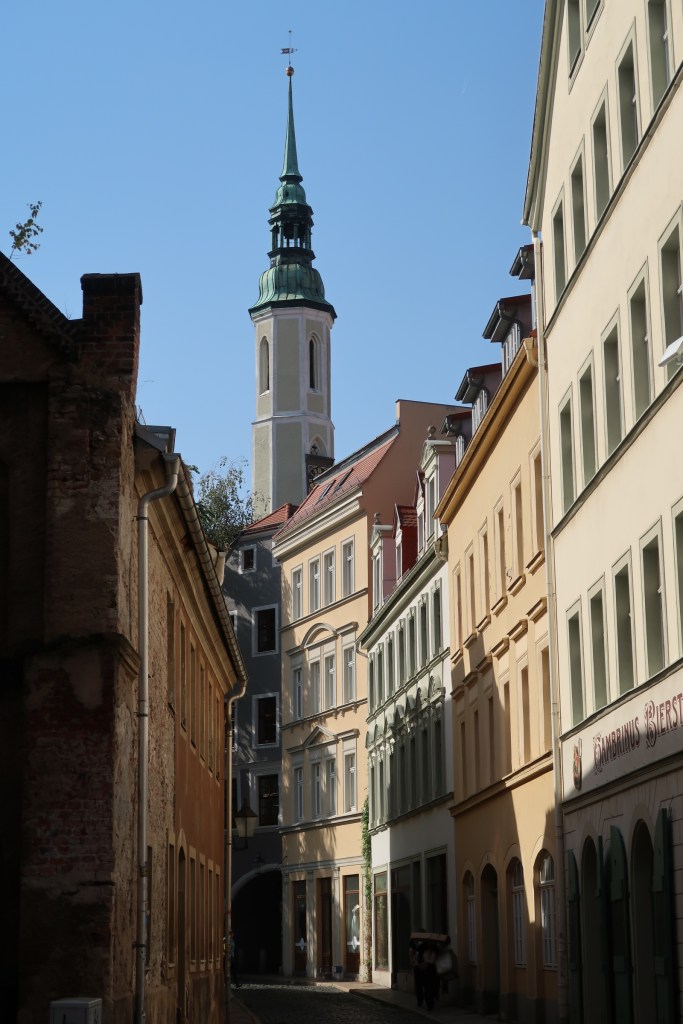
This ever-evident history envelops you as you walk along the city’s cobbled streets. There’s the Baroque Brauner Hirsch (Brown Deer) building, first mentioned in 1403, reconstructed in 1722, and named after the statue prominently poking out from the corner. Across the square is the Schönhof, Görlitz’s oldest Renaissance building, with ceilings and wall paintings dating back to the 16th century (the Silesian Museum inside is well worth a visit). It’s very hard to miss the slender Old Town Hall (Rathaus), the tower of which was built in the 16th century and features elaborate clocks plus an audibly roaring lion.
I’ve barely touched on the old buildings that are must-sees, if I continued then this story would be full of architecture (again, do check out Solo Travel Story’s piece for more detail). For now I’m going to continue along the Via Regia – the ancient royal highway that spans 4,500km from Moscow to Santiago de Compostela – down to the Lusatian Neisse river which, at the time of my visit, was heavily swollen by rainwater.

One of the many incredible aspects of the European Union is how countries which not so long ago were at war now seemingly have no border at all. The Lusatian Neisse is the border between Germany and Poland and a wide pedestrianised bridge crosses the river, but apart from some very subtle CCTV on the German side there’s nothing to indicate you’re walking from one country to the next. Long may this be the case, although I know that things are already taking a turn for the worse.
The Polish side of the city is called Zgorzelec and, although it still has some old buildings, there aren’t anywhere near as many as in Görlitz. I recommend strolling along the river to the Czarna Caffka café for generous portions of delicious cakes. Still on the Polish side the imaginatively-named Food Court just to the north of the bridge is a great place to enjoy an al fresco drink while watching the sun set.
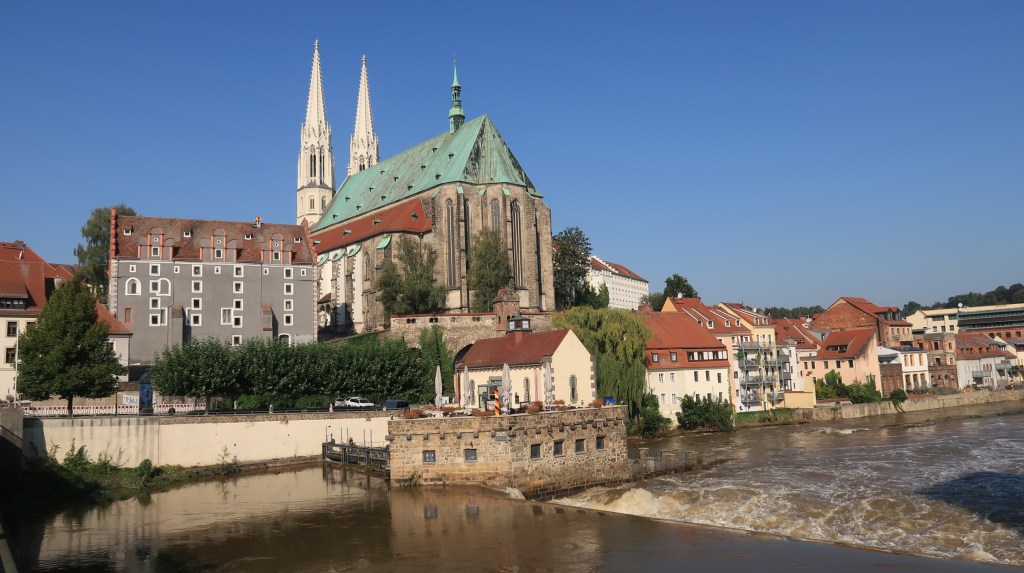
Crossing back into Germany affords an excellent view of the Woad House, the origins of which can be traced to the 12th century, as well as Görlitz’s Gothic St Peter’s Church, the largest of its kind in Saxony and completed in 1497. On certain days (see here) at midday there’s a recital featuring the special organ – built in 1703 by a famous Italian organ maker – which can mimic bird song. Have a listen below:
Because of Görlitz’s pristine streets, and because they have consequently attracted myriad movie makers, the city has earned the moniker “Görliwood“. One of my favourite films is The Grand Budapest Hotel and, lo and behold, everywhere I turned in Görlitz I recognised a scene. Wes Anderson and cast spent 10 weeks in 2013 filming here, the hotel itself is the city’s Kaufhaus Görlitz, a splendid early 20th century department story. Hopefully it’ll reopen soon but for now, if you’re a fan like me, you’ll have to peer through the glass doors and slowly come to the realisation that you’re looking at the lobby of the eponymous hotel.

Normally I’d recommend a hotel and restaurant in a post such as this, but as I was travelling solo and on a very strict budget where I stayed and ate may not be to most peoples’ taste. The hotel was the perfectly functional Gästehaus Lisakowski, a pleasant 15-minute walk through Baroque streets to where the main sights of the city are located. The lovely old Turkish man at Ali’s Imbiss kebab place who spoke not only his own language but German too unfortunately didn’t speak a word of English. Despite my terrible German we managed to sufficiently understand one another for me to order a HUGE and delicious meal for less than €9.
As you can see there’s much to commend a visit to Görlitz. It should absolutely be a UNESCO-listed site, not least for its impressive Hall Houses. Alas it still only remains a contender. The city is directly connected by train to Dresden, which is where you’ll find the nearest airport. I took a Flixbus from Berlin, transferring in Dresden (which is well worth spending time in), a journey of around 6 hours.
 A Plan To Go